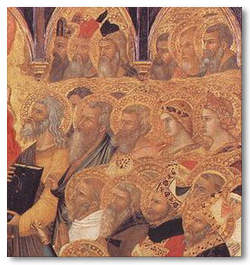
 Let us first address the Feast of All Saints. The exact origins of this celebration are uncertain, although, after the legalization of Christianity in 313, a common commemoration of Saints, especially the martyrs, appeared in various areas throughout the Church. For instance in the East, the city of Edessa celebrated this feast on May 13; the Syrians, on the Friday after Easter; and the city of Antioch, on the first Sunday after Pentecost. Both St. Ephrem (d. 373) and St. John Chrysostom (d. 407) attest to this feast day in their preaching. In the West, a commemoration for all the saints also was celebrated on the first Sunday after Pentecost. The primary reason for establishing a common feast day was because of the desire to honor the great number of martyrs, especially during the persecution of Emperor Diocletion (284-305), the worst and most extensive of the persecutions. Quite supply, there were not enough days of the year for a feast day for each martyr and many of them died in groups. A common feast day for all saints, therefore seemed most appropriate.
Ipinapakita ang mga post na may etiketa na All Saints and All Souls Day. Ipakita ang lahat ng mga post
Ipinapakita ang mga post na may etiketa na All Saints and All Souls Day. Ipakita ang lahat ng mga post
Biyernes, Nobyembre 04, 2011
All Saints and All Souls Day
Both the Feast of All Saints and the Feast of All Souls evolved in the life of the Church independently of paganism and Halloween. However, elements of pagan practices were perhaps “baptized” by some cultures or attached themselves to the celebration of All Saints and All Souls.
 Let us first address the Feast of All Saints. The exact origins of this celebration are uncertain, although, after the legalization of Christianity in 313, a common commemoration of Saints, especially the martyrs, appeared in various areas throughout the Church. For instance in the East, the city of Edessa celebrated this feast on May 13; the Syrians, on the Friday after Easter; and the city of Antioch, on the first Sunday after Pentecost. Both St. Ephrem (d. 373) and St. John Chrysostom (d. 407) attest to this feast day in their preaching. In the West, a commemoration for all the saints also was celebrated on the first Sunday after Pentecost. The primary reason for establishing a common feast day was because of the desire to honor the great number of martyrs, especially during the persecution of Emperor Diocletion (284-305), the worst and most extensive of the persecutions. Quite supply, there were not enough days of the year for a feast day for each martyr and many of them died in groups. A common feast day for all saints, therefore seemed most appropriate.
Let us first address the Feast of All Saints. The exact origins of this celebration are uncertain, although, after the legalization of Christianity in 313, a common commemoration of Saints, especially the martyrs, appeared in various areas throughout the Church. For instance in the East, the city of Edessa celebrated this feast on May 13; the Syrians, on the Friday after Easter; and the city of Antioch, on the first Sunday after Pentecost. Both St. Ephrem (d. 373) and St. John Chrysostom (d. 407) attest to this feast day in their preaching. In the West, a commemoration for all the saints also was celebrated on the first Sunday after Pentecost. The primary reason for establishing a common feast day was because of the desire to honor the great number of martyrs, especially during the persecution of Emperor Diocletion (284-305), the worst and most extensive of the persecutions. Quite supply, there were not enough days of the year for a feast day for each martyr and many of them died in groups. A common feast day for all saints, therefore seemed most appropriate. 

Mag-subscribe sa:
Mga Post (Atom)